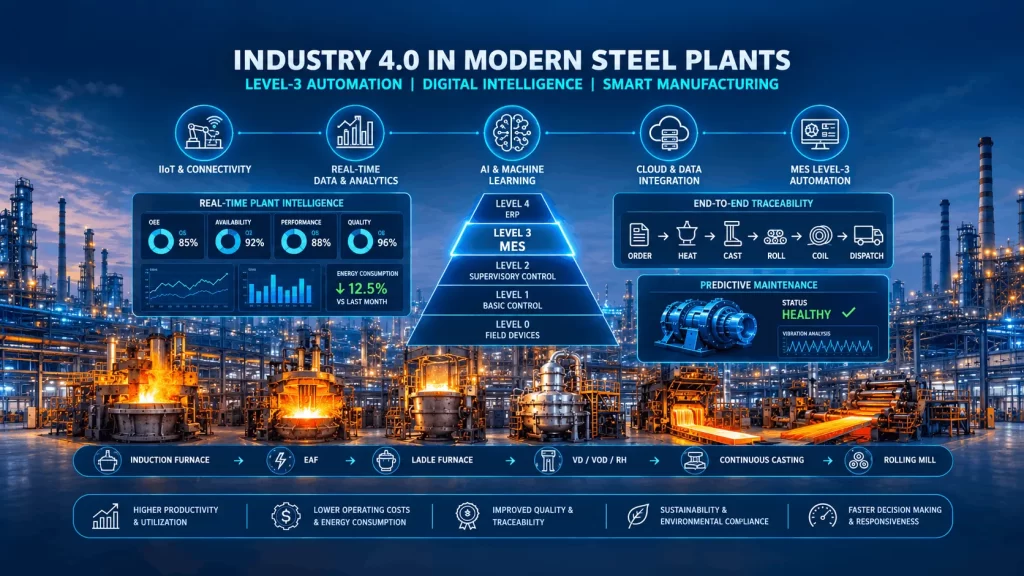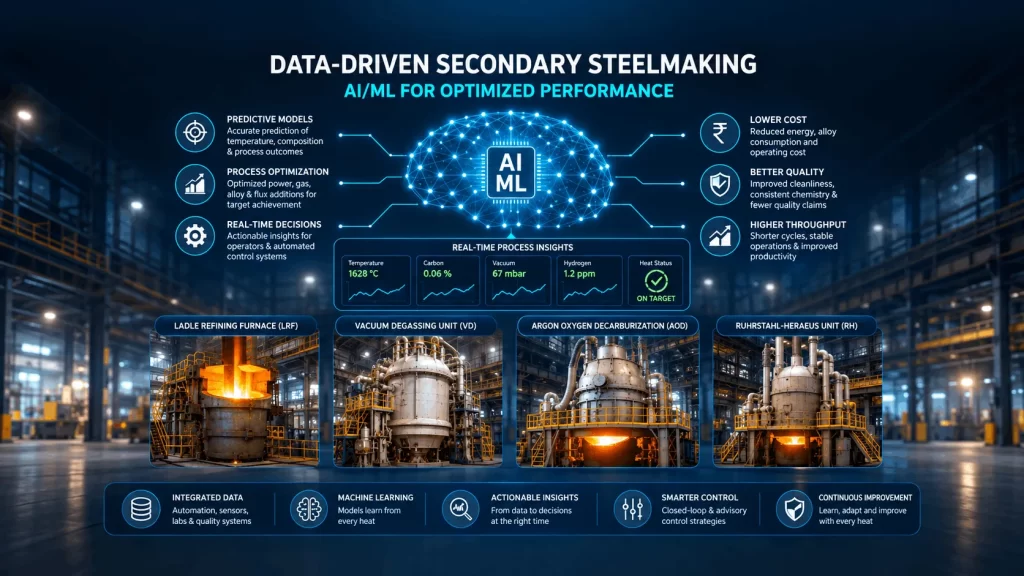
- Why AI & ML matter In Secondary Steel Making
Secondary Metallurgy — LF, VD/RH, AOD/VOD — is where final chemistry, temperature, and cleanliness are set. These directly affect caster stability as well as required grain orientation, rolling yield, energy & alloy optimization, and customer quality performance.
Modern plants already generate large volumes of real time data from automation systems, labs, and quality systems, but most it is used only for monitoring and sometimes for implementation of Process Automation Systems – but not process optimization. AI and Machine Learning (ML) can turn this data into actionable insight and, over time, more automated control – delivering measurable improvements in cost, quality, and throughput without replacing metallurgists and operators.
AI-based automation uses machine learning and reasoning to process unstructured data, make contextual decisions and adapt dynamically without human intervention and effectively delivering measurable improvements in cost, quality, and throughput without replacing metallurgists and operators. Each process AI has its own specific optimization targets
- Where AI/ML creates value in Secondary Metallurgy?
A. More Consistent Heats, less Rework
Problem: Variable tap conditions, scrap mix, and alloy yields make it hard to consistently hit temperature and composition targets in LF and degassers. Overheating and alloy overshoot waste energy and money; under-heating disrupts casting.
AI Solution: Predictive models estimate end-of-treatment temperature and composition from current bath state, power profile, gas flows, and planned additions. Operators receive recommended power and alloy strategies to hit targets with minimal margin. AI is generally focused on creating technology that can dynamically respond to new information and complete tasks without human intervention
Impact:
– Fewer re-heats and re-blows
– Tighter temperature windows at caster (e.g. ±5–7 °C vs ±10–12 °C)
– Lower alloy and energy consumption per ton of liquid steel
– Reduced off-spec and re-refined heats
B. Shorter, Smarter Degassing Cycles
Problem: Vacuum degassing (VD/RH/VOD) is often run with fixed planning despite varying initial content of H/N/O/C, temperature, and equipment condition.
AI Solution: Time-series models predict gas removal trajectories and required treatment time under current conditions. Anomaly detection flags vacuum curve deviations (leaks, pump issues) early.
Impact:
– Shorter degassing cycles without compromising H/N/O targets
– Lower steam and power use
– Fewer hydrogen- and inclusion-related defects in critical grades
C. Lower Alloy cost with Controlled risk
Problem: Alloy additions are a major variable cost. Uncertainty about yields and downstream properties leads to conservative over-addition.
AI Solution: Models link final chemistry and process route to mechanical properties. Optimization tools recommend the minimum-cost alloy strategy that meets specs and property targets with acceptable risk.
Impact:
– Typical alloy cost reductions of 1–3% per ton (significant at scale)
– Less property variability between heats
– Better alignment between melt shop practice and final product performance
D. Better Cleanliness and fewer Quality Claims
Problem: For high-grade steels (bearing, automotive, energy), inclusion population is critical. Secondary metallurgy is where de-oxidation, desulfurization, and inclusion modification happen, but practice can drift.
AI Solution: Models link slag practice, de-oxidation, and stirring to inclusion metrics; image-based AI classifies inclusions from micrographs. Operators get recommendations on slag and Ca treatment to achieve target cleanliness.
Impact:
– More consistent inclusion ratings for critical grades
– Fewer inclusion-related defects and customer claims
– Greater confidence to produce higher-performance grades
E. Faster Troubleshooting and Continuous Learning
Problem: When a heat goes wrong (off-spec chemistry, high H, temperature drift), root-cause analysis is slow and manual.
AI Solution: Anomaly detection highlights unusual heats; tools show which factors (e.g., high initial H, low argon flow, slow vacuum curve) contributed most.
Impact:
– Faster resolution of recurring problems
– Systematic learning from “bad” heats instead of ad hoc investigations
– Early detection of process drifts before they cause major quality issues
- Bottom line for Senior Management
AI and data analytics in secondary metallurgy are no longer experimental; they are practical tools that can:
– Reduce energy and alloy costs per ton
– Improve consistency of temperature, chemistry, and cleanliness
– Shorten refining and degassing cycles
– Lower off-spec rates and quality claims
Steel Plants that start with focused AI/ML tools implementation, build a solid data foundation, and scale gradually will create a durable competitive advantage in cost, quality, and flexibility.
- Process and Maintenance
Process malfunctions are always related to maintenance. AI tool’s inherent properties promptly takes care the intra relations and improve quality production.