The global steel industry is undergoing a profound digital transformation driven by the principles of Industry 4.0. Increasing market competition, stringent quality requirements, rising energy costs and sustainability targets are compelling steel manufacturers to adopt intelligent manufacturing systems that improve productivity while reducing operational costs. Unlike conventional automation, Industry 4.0 integrates production equipment, process data and enterprise-level decision-making into a connected digital ecosystem, enabling steel plants to operate as smart, self-optimizing facilities.
At the heart of this transformation lies the seamless integration of advanced automation, Industrial Internet of Things (IIoT), artificial intelligence (AI), cloud computing and real-time analytics. Together, these technologies enable steel producers to transition from reactive operations to predictive and data-driven manufacturing. The objective is no longer limited to automating individual machines but to create an interconnected production environment where every process—from raw material charging to finished product dispatch—is continuously monitored, analysed and optimized.
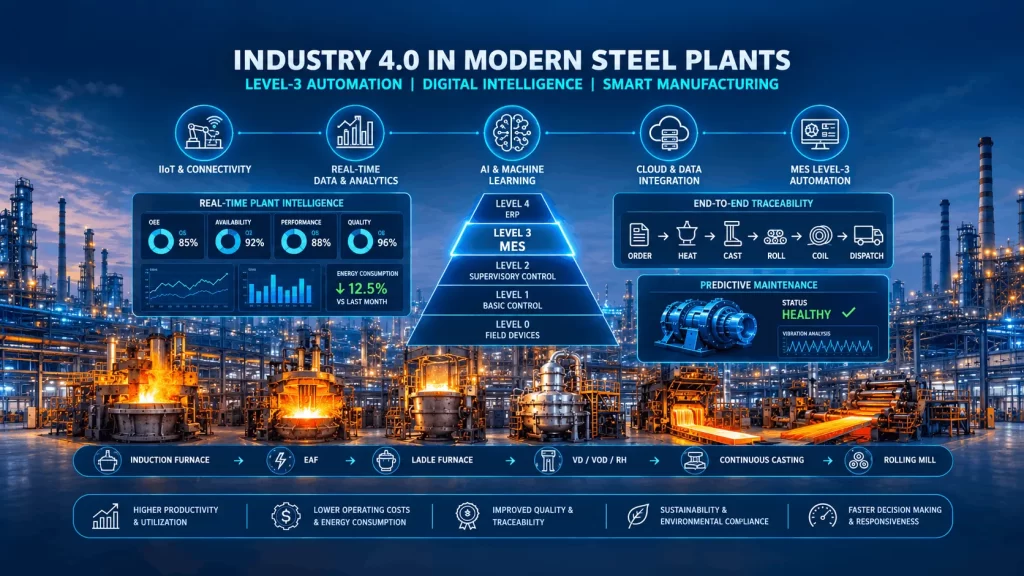
While Level-1 and Level-2 automation have long been standard in steel plants for controlling individual equipment and process parameters, the true value of Industry 4.0 is realized through Level-3 Automation, commonly referred to as the Manufacturing Execution System (MES). Acting as the digital bridge between Enterprise Resource Planning (ERP) systems and plant-floor automation, MES transforms isolated process data into actionable production intelligence.
A Level-3 automation system integrates production scheduling, order management, heat tracking, material genealogy, production reporting, quality management and inventory control into a unified platform. Every heat of steel, ladle, billet or coil is digitally tracked throughout the manufacturing process, ensuring complete traceability and real-time visibility. Production schedules generated from customer orders are automatically translated into shop-floor instructions, while live production data is continuously fed back to management systems for performance monitoring and informed decision-making.
This real-time integration enables production managers to identify process deviations, equipment bottlenecks and quality issues before they impact downstream operations. The result is improved production planning, optimized resource utilization, enhanced product traceability and faster response to changing customer demands. For steel producers operating multiple furnaces, casting machines and rolling mills, Level-3 automation becomes the central intelligence layer that synchronizes the entire manufacturing value chain.
The effectiveness of Industry 4.0, however, depends on reliable data acquisition from every critical asset within the plant. This is achieved through the Industrial Internet of Things (IIoT), where thousands of intelligent sensors continuously monitor temperatures, pressures, vibrations, flow rates, electrical parameters and metallurgical variables. Combined with secure industrial communication protocols and centralized data historians, IIoT creates a digital representation of the plant that supports advanced analytics and predictive decision-making.
The practical benefits of this digital ecosystem are particularly evident in steelmaking operations.
In Induction Furnaces, digital monitoring systems continuously analyse electrical power consumption, melting rates, lining temperatures and cooling water performance. Historical operating data can be used to predict refractory wear, optimize melting cycles and minimize unplanned shutdowns while improving energy efficiency.
For Electric Arc Furnaces (EAFs), Industry 4.0 enables intelligent optimization of the melting process by analysing arc stability, electrode consumption, oxygen injection, power input and furnace chemistry in real time. AI-assisted models recommend optimum melting practices, reducing specific energy consumption, improving productivity and extending electrode and refractory life. Predictive maintenance of transformers, hydraulic systems and electrode regulation equipment further enhances furnace availability.
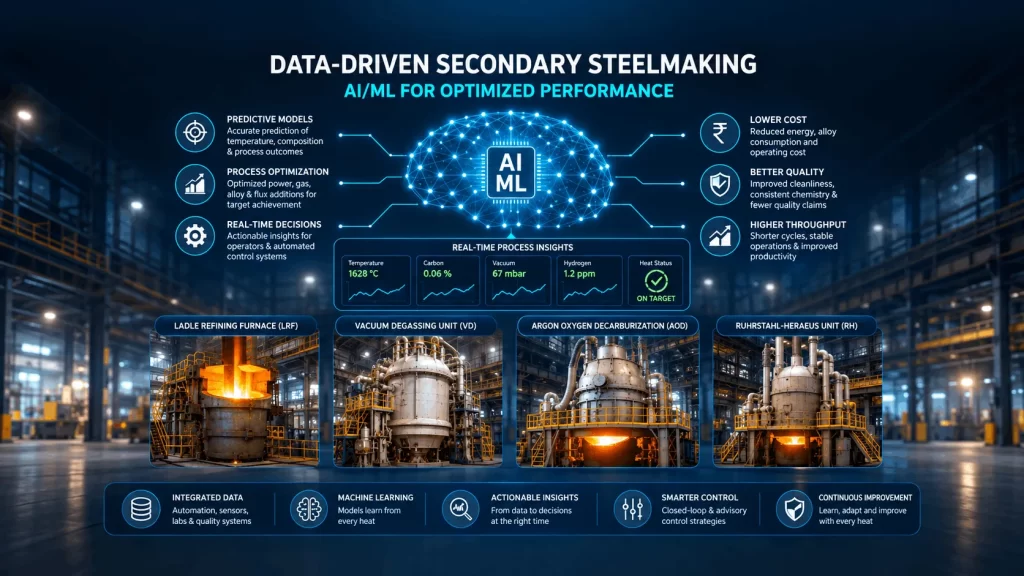
Secondary metallurgy offers even greater opportunities for digital optimization. In Ladle Furnaces (LFs), process models can optimize alloy additions, slag chemistry, power input and refining time to achieve the desired steel composition with minimum material consumption. Online monitoring of ladle temperatures and refractory conditions improves operational reliability while maintaining consistent steel quality.
In Vacuum Degassing (VD/VOD) and RH Degassing units, intelligent process control supports optimization of vacuum cycles, hydrogen removal, decarburization efficiency and alloy recovery. Real-time monitoring of vacuum pump performance, process pressure and treatment duration ensures repeatable metallurgical results while reducing treatment costs.
Similarly, Argon Oxygen Decarburization (AOD) converters used in stainless steel production benefit from AI-assisted control of oxygen and argon injection, decarburization rates and alloy additions. Continuous analysis of process variables enables improved chemistry control, reduced refining time and enhanced alloy yield.
The advantages of Industry 4.0 extend beyond steel refining into downstream production processes. In Continuous Casting Machines, advanced monitoring systems combine mold-level sensors, breakout prediction algorithms, electromagnetic stirring controls and secondary cooling models to improve casting stability and minimize surface and internal defects. Integration with Level-3 automation ensures complete traceability of every heat and billet while providing valuable quality data for downstream rolling operations.
Likewise, Rolling Mills are increasingly adopting digital technologies to optimize reheating furnace operation, rolling schedules, mill speeds, roll wear, controlled cooling and finished product quality. IIoT-based vibration monitoring of gearboxes, bearings and motors enables predictive maintenance, reducing unexpected equipment failures. Automated process analytics help maintain dimensional accuracy, mechanical properties and surface quality while maximizing mill throughput and minimizing energy consumption.
An equally important aspect of Industry 4.0 is the application of advanced digital tools such as artificial intelligence, machine learning and digital twins. AI algorithms analyse historical production data to identify hidden process relationships that are impossible to detect through conventional statistical methods. Machine learning continuously improves prediction accuracy as additional production data becomes available, while digital twin technology creates virtual models of production equipment that allow engineers to simulate process changes before implementing them on the plant floor. These capabilities significantly reduce operational risks while accelerating process optimization.
Despite the sophistication of these technologies, successful digital transformation is not achieved by technology alone. Industry 4.0 complements rather than replaces sound metallurgical practices, disciplined operations and robust process engineering. The most successful steel plants are those that combine metallurgical expertise with digital intelligence to support faster, more informed decisions across every stage of production.
As steel manufacturers continue their journey toward smart manufacturing, Industry 4.0 will increasingly become a strategic necessity rather than a competitive advantage. By integrating Level-3 automation, MES, IIoT and intelligent process analytics, modern steel plants can achieve higher productivity, improved product quality, lower energy consumption and enhanced operational reliability. The future of steelmaking lies not merely in automated equipment, but in intelligent, connected and data-driven manufacturing systems capable of continuously learning, adapting and optimizing every aspect of production.